Why the Collation Infeed Defines 90% of Cartoner Uptime
An automatic cartoner erecting and gluing paperboard boxes is mechanically straightforward; the real engineering challenge inside secondary multipack and cartoning is catching 200–800 primary packs/min off multi-lane stick packers, HFFS wrappers, or JDXD-180 horizontal pouchers (60–120 pouches/min), verifying every single unit is present, orienting flat or on-edge stacks, and pushing clean counts into moving carton buckets without dog-earing seals.
Integrated systems (such as Universal Pack Alfa + Synthesis stick-to-carton architectures) eliminate manual intermediate trays by mechanically slaving the counting stacker to the primary cutter shaft.
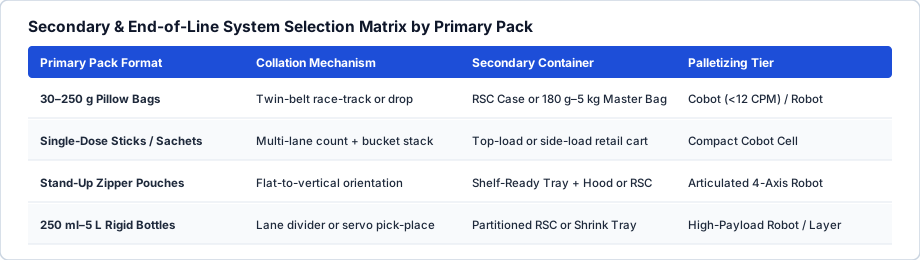
Collation Feeder Mechanisms by Primary Product
Matching primary discharge geometry to high-efficiency cartoner infeeds:
| Primary Machine | Collation Infeed Mechanism | Count / Orientation | Cartoner Motion Tier |
|---|---|---|---|
| 4–16 Lane Stick Packer | Pick-up shuttle + vertical bucket cascade | 5–60 sticks flat or upright | Intermittent / Cont. Side or Top-Load |
| 4-Side Sachet / JDXD-180 Pouch | Shingling belt + rotary pocket stacker | 1–20 pouches shingled/stacked | Horizontal Intermittent (40–100 CPM) |
| Bakery / Candy Flow Wrapper | Servo smart-belt phase gapping + twin race-track | 1–12 bars in 1–3 layers | Continuous Horizontal (100–250 CPM) |
| Blister / Tube / Bottle Filler | Starwheel / screw turner + leaflet folder | 1–4 units + GUK folded insert | cGMP Balcony Horizontal Cartoner |
Need outer cellophane or BOPP film bundling after cartoning? Connect directly to end-of-line packaging systems.
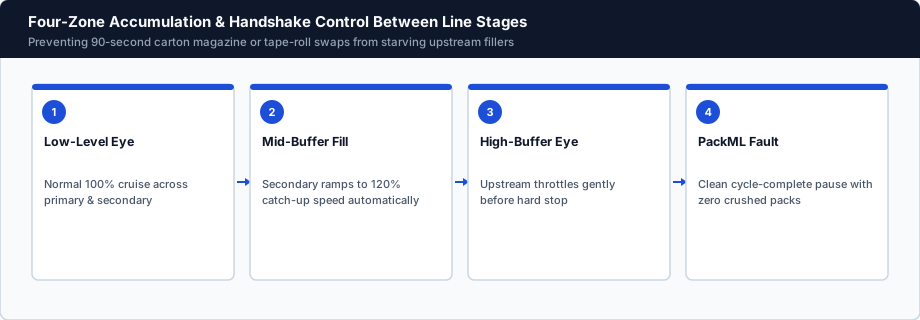
System Integration Engineering Notes
- Incomplete-Bucket No-Carton / No-Load Logic: If vision or height sensors detect 9 sticks instead of 10 in a collation bucket, the cartoner skips pulling a paperboard blank and diverts the partial stack cleanly for reuse.
- Pre-Breaking 180° Carton Score Lines: Rotary vacuum erectors pre-fold rigid carton creases past 150° before squaring back to 90°, stopping stiff virgin SBS board from springing open before glue compression.
- Laser / TIJ Serialization + Tamper-Evident Labels: Integrate 600 dpi TIJ lot/2D coding and dual-corner tamper-evident labels directly on the cartoner outfeed.
Engineer Your Stick, Pouch, or Flow-Wrap Cartoning Cell
Share primary lane count, cycle speed, and carton dimensions (A × B × C mm) via Project Brief.
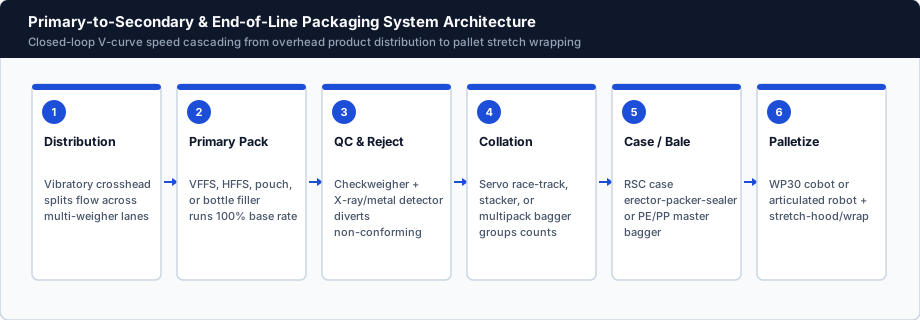
Explore related system modules in Packaging Line Systems, Line Balancing & OEE Specs, or send your floorplan & target BPM via Project Brief.
Related Specifications
Further Reference
Request Project Configuration Review
Share layout constraints, architectural drawings, or throughput targets with Packaging Line Systems Technical Group.
Review My Line Layout