Five Mechanical & Control Traps Between Primary and Secondary Machines
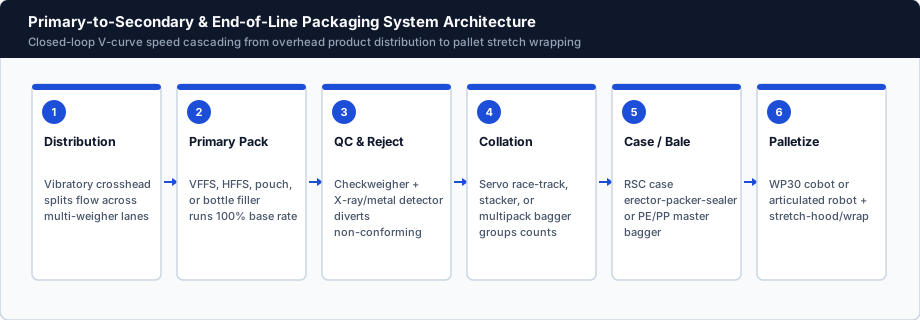
Ninety percent of commissioning headaches happen in the 3-meter transition zone after a pouch drops out of a primary bagger and before it enters a cartoner or case loader. Grounded in line sizing and turnkey planning and system integration and line balancing, clean integration controls bag thickness, center-to-center pitch, defect rejection, and speed modulation.
Fixing these five transfer physics rules on paper eliminates field rework on startup week.
Primary-to-Secondary Interface Engineering Checklist
Standard mechanical treatments from primary discharge chute to secondary infeed:
| Transition Step | Failure Mode If Omitted | Engineered Hardware Solution |
|---|---|---|
| 1. Takeaway Inclined Cleat/Belt | Hot seals stretch or scuff under bagger | Low-drop smooth PU belt + air-jet seal cool |
| 2. Spring Dual-Belt Bag Flattener | Puffed pillow bags miss case count / pop | Adjustable compression belt evens thickness |
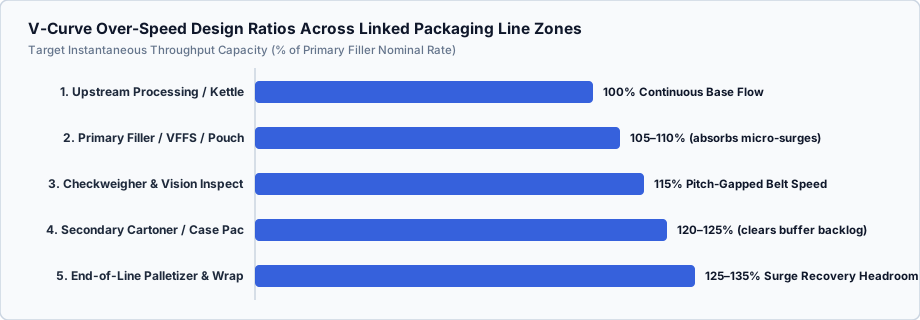
| 3. Pitch-Gapping Speed-Up Belt | Two touching bags weigh as one double | 15–20% belt step-up separates packs cleanly |
| 4. Combo Checkweigher + Metal/X-Ray | Bad single pack ruins entire 24-count case | Retracting-nose or air-blast single-pack reject |
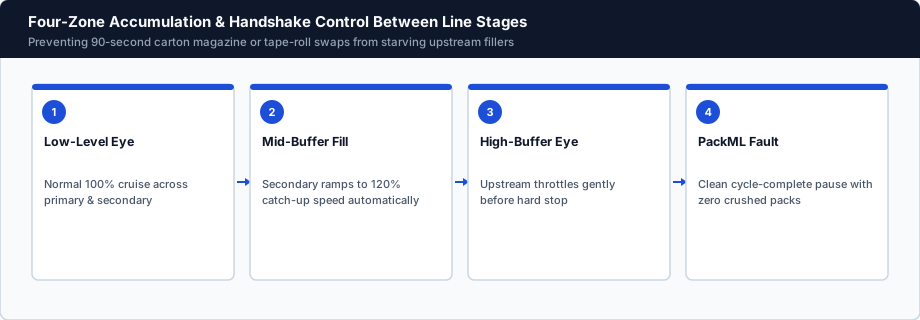
| 5. FIFO / Race-Track Buffer | Carton blank reload halts primary VFFS | 45–90s accumulation + PackML VFD trim |
Size exact catch-up speeds and buffer lengths in our line balancing and buffer calculator.
System Integration Engineering Notes
- Knife-Edge Transfers for Small Sachets & Sticks: Standard 50 mm conveyor rollers swallow 70 mm sachets—specify 6–8 mm micro-nosebar knife-edge transfers across every conveyor junction.
- Static Elimination on High-Speed BOPP Films: Mount active ionizing bars before collation stacks so lightweight flow-wrapped wafers or tea envelopes don’t cling to guide rails.
- Dry-Contact vs Ethernet/IP PackML: Legacy primary machines without Ethernet still integrate cleanly via 4-wire 24V DC relay handshakes (
Upstream Ready,Downstream Ready,Speed High/Low,E-Stop).
Audit Your Primary-to-Secondary Transfer Zone
Send smartphone video or drawings of your current primary discharge via Project Brief.
Explore related system modules in Packaging Line Systems, Line Balancing & OEE Specs, or send your floorplan & target BPM via Project Brief.
Related Specifications
Further Reference
Request Project Configuration Review
Share layout constraints, architectural drawings, or throughput targets with Packaging Line Systems Technical Group.
Review My Line Layout