Proven End-to-End Topologies by Product Physics
A savoury potato-chip distribution gallery behaves nothing like a 5-liter corrosive chemical bottling hall or a 10-lane nutraceutical stick-in-carton suite. Grounded in system integration and line balancing, our engineering blueprints standardize elevation heights, sanitary washdown zones, accumulation buffers, and utility headers for each sector.
Reviewing reference line blueprints early prevents costly ceiling-height surprises under multihead mezzanines and forklift aisle conflicts at pallet discharge.
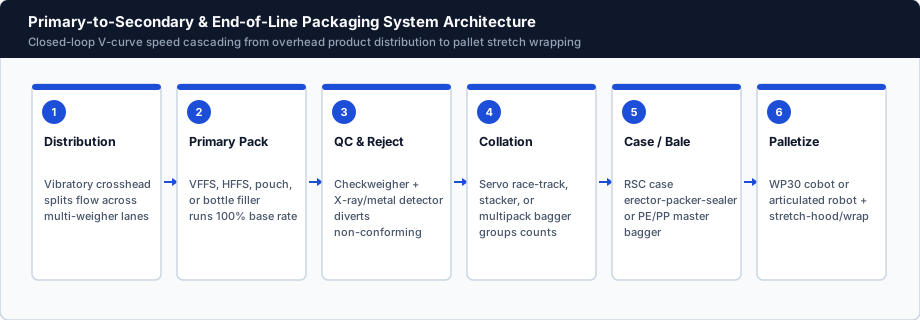
Reference Turnkey Line Topologies by Sector
Typical machine sequences and line output benchmarks:
| Industry Blueprint | Upstream-to-Primary Core | Secondary & End-of-Line Core | Typical System Output |
|---|---|---|---|
| Snack & Granule Multi-Bagger | Vibratory distribution + 14/16H weighers + VFFS | Multipack R800 bagger or RSC case + palletizer | 120–600 primary BPM |
| Bulk Food / Pet / Ag Master Line | Net-weigh / auger + 10–25 kg FFS or open-mouth | Bag flattener + metal detect + robot palletizer | 8–22 heavy bags/min |
| Rigid Bottle Liquid System | CLP-650 unscrambler + 6–12 nozzle servo filler | Torque capper + front/back label + case packer | 40–120 bottles/min |
| Stick / Pouch Retail Cartoning | Multi-lane stick or JDXD-180 poucher (60–120 PPM) | Count-stack collator + cartoner + overwrapper | 40–150 cartons/min |
Inspect full layouts in snack and granule multi-weigher lines and liquid bottle to pallet lines.
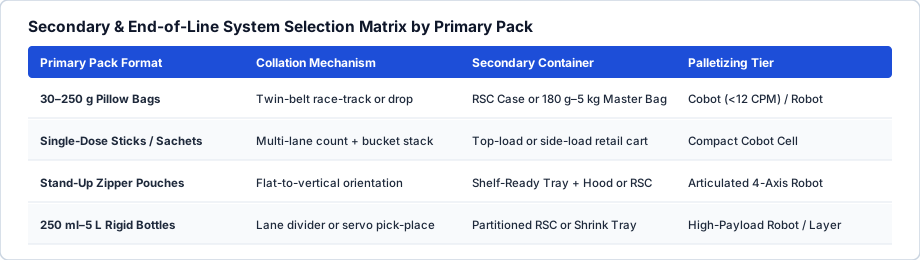
System Integration Engineering Notes
- Mezzanine vs Low-Profile Floor Layout: Multihead VFFS clusters normally require 3.8–5.2 m ceiling clearance; low-ceiling halls can split weighing or use horizontal premade pouchers (
1.6–2.1 mtall). - Wet-Zone vs Dry-Zone Wall Bulkheads: In liquid and dairy plants, pass capped-and-dried bottles through a stainless wall aperture so corrugated case packers and cobot palletizers stay in dry ambient air.
- Centralized Dust & Trim Vacuum Headers: Connect powder fillers, stick slitters, and cartoners to a shared HEPA dust-extraction manifold.
Request a CAD Block Layout for Your Building
Send your hall L × W × H dimensions and column grid via Project Brief.
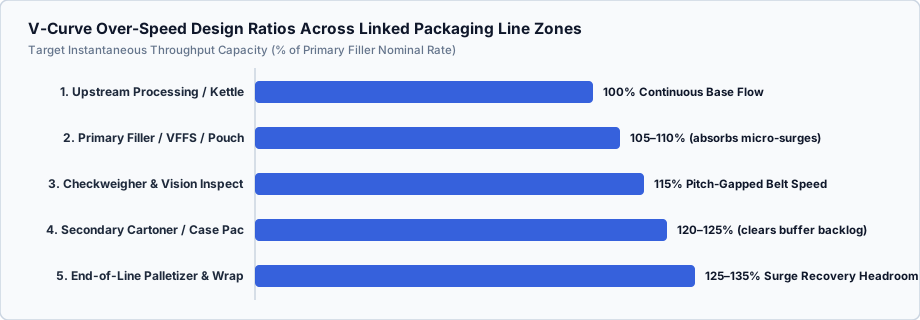
Explore related system modules in Packaging Line Systems, Line Balancing & OEE Specs, or send your floorplan & target BPM via Project Brief.
In This Section
Related Specifications
Further Reference
Request Project Configuration Review
Share layout constraints, architectural drawings, or throughput targets with Packaging Line Systems Technical Group.
Review My Line Layout