Turning Loose Primary Packs Into Warehouse-Ready Unit Loads
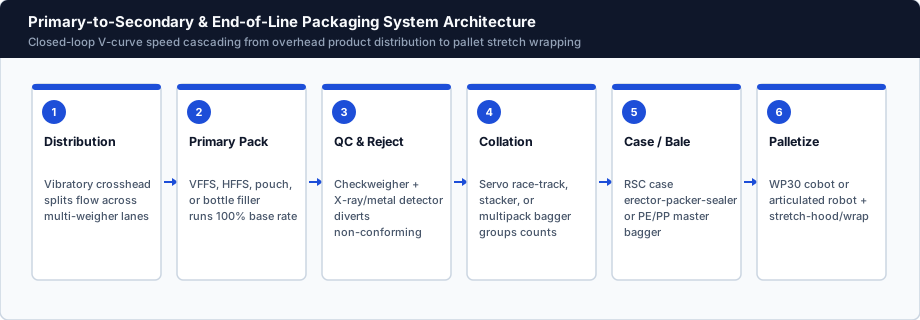
End-of-line packaging is typically the last manual island in food, chemical, and consumer-goods plants—often tying up 4 to 8 operators per shift erecting RSC boxes, hand-packing pouches, taping flaps, and lifting 12–25 kg cartons onto wooden pallets. Within our packaging line systems architecture, end-of-line modules replace repetitive manual lifting with synchronized case packers, secondary master balers, robotic palletizers, and automatic pallet wrappers.
Depending on shipping distribution channels, primary packs either load into corrugated RSC/shelf-ready trays or group inside heavy-duty 140–180 μm PE / woven-PP secondary master bags.
End-of-Line Equipment Architecture Comparison
Compare shipping containment and palletizing modules by speed and payload:
| End-of-Line Module | Throughput Range | Container / Payload Spec | Floor Footprint Advantage |
|---|---|---|---|
| RSC Case Erector + Loader + Sealer | 8–25 cases/min | Corrugated RSC / HSC / SRP trays | Inline linear or compact monoblock |
| Secondary PE / Woven-PP Master Bagger | 6–18 master bales/min | 650–900 × 350–450 mm (140–180 μm PE) | Cuts corrugated board spend 50–65% |
| WP30 Cobot Carton Palletizer | Up to 8–12 cartons/min | Dual pallet bays; fenceless scanner option | Fits 2.5 × 3.2 m tight retrofit aisles |
| 4-Axis Articulated Robotic Palletizer | 15–35+ cartons or bags/min | Multi-pick vacuum/fork + slip-sheet | Services 2–3 lines simultaneously |
Dive deeper into case erectors, packers, and sealers and robotic and cobot palletizing cells.
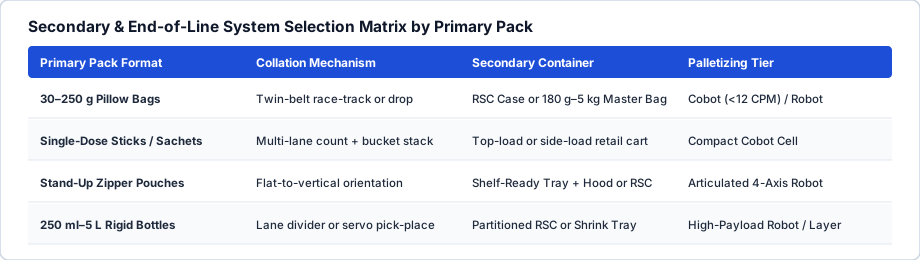
System Integration Engineering Notes
- Tape vs Nordson-Class Hot-Melt Case Sealing: Hot-melt EVA/metallocene glue seals faster above 15 cases/min and adds structural stacking rigidity in humid cold-storage warehouses.
- Automatic Empty-Pallet Dispenser + Slip-Sheet: Pair high-speed robotic cells with a 15-pallet magazine dispenser and rotary arm stretch wrapper for 2+ hours of forklift-free autonomy.
- GS1-128 Print-and-Apply Pallet/Case Labeling: Dual-panel corner-wrap applicators verify SSCC-18 pallet barcodes before warehouse WMS scan-in.
Scope Your End-of-Line Automation Cell
Provide case/bale dimensions (L × W × H), gross weight, cases/minute, and pallet Ti × Hi pattern via Project Brief.
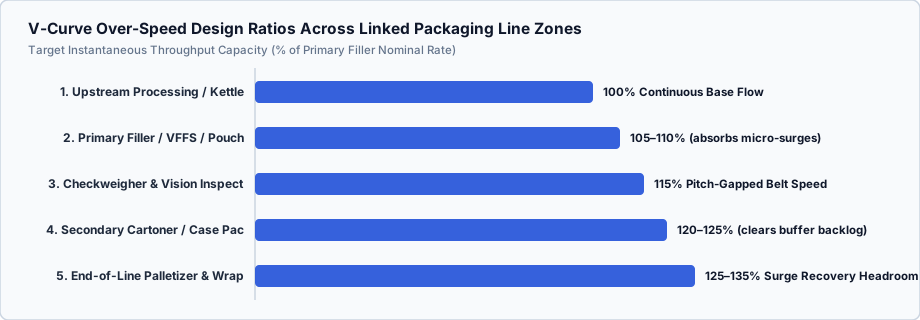
Explore related system modules in Packaging Line Systems, Line Balancing & OEE Specs, or send your floorplan & target BPM via Project Brief.
In This Section
Related Specifications
Further Reference
Request Project Configuration Review
Share layout constraints, architectural drawings, or throughput targets with Packaging Line Systems Technical Group.
Review My Line Layout