Matching Case Loading Kinematics to Flexible vs Rigid Packs
Inside end-of-line packaging systems, the case packer must respect primary package physics: dropping heavy glass sauce jars fractures containers, whereas side-pushing soft pillow snack bags wrinkles seals and jams flaps. Selecting between gravity drop, vacuum/mechanical pick-and-place, horizontal side-load, and wrap-around flat-blank packers locks line reliability.
Upstream RSC case erectors use dual opposing vacuum frames (positive pin-and-dome opening) so warped or recycled corrugated blanks square cleanly at 90 degrees even in humid summer warehouses.
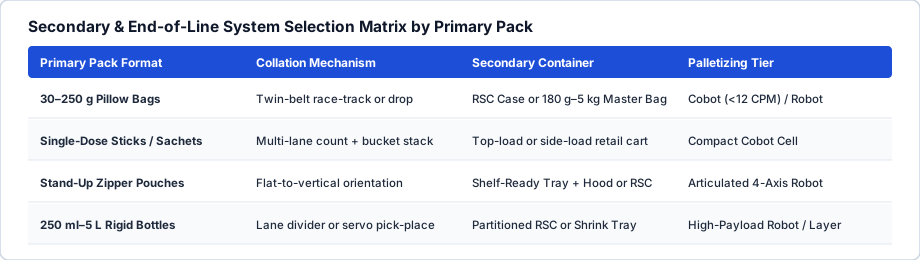
Case Packer Loading Mechanism Matrix
Engineering comparison across the four industrial case-packing architectures:
| Case Packer Style | Speed (Cases/Min) | Ideal Primary Pack | Key Mechanical Advantage |
|---|---|---|---|
| Gravity / Soft-Drop Packer | 10–25 CPM | Pillow snack bags, frozen VFFS pouches | Fastest cycle for durable flexible bags |
| 2-Axis / Delta Pick-and-Place | 8–22 CPM | Stand-up pouches, bottles, tubs, trays | Gentle vertical placement + layer slip-sheets |
| Horizontal Side-Load Packer | 10–25 CPM | Rigid cartons, gable-top bricks, canisters | Smallest footprint for stackable cartons |
| Wrap-Around / SRP Tray-Hood | 15–35 CPM | Cans, dairy cups, retail-ready pouches | Tightest board fit; saves 12–18% corrugated |
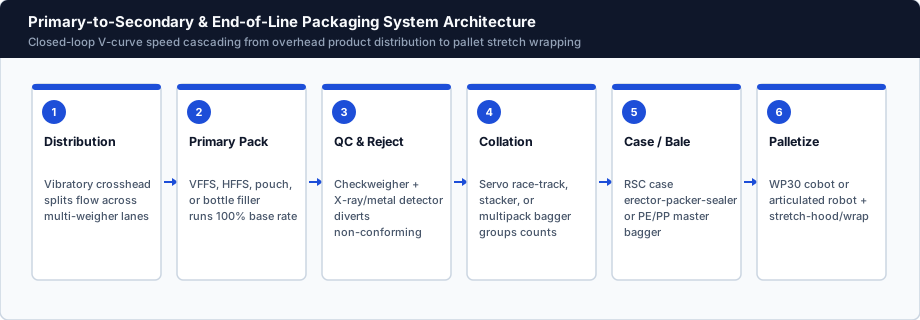
Complete the line downstream with robotic and cobot palletizing cells.
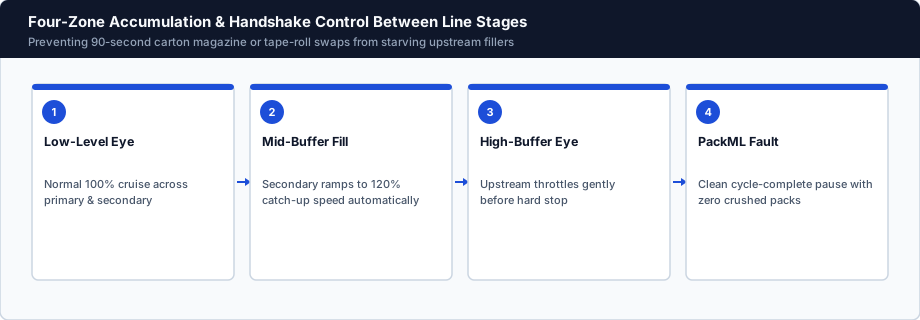
System Integration Engineering Notes
- Opposing Dual-Vacuum Case Opening: Single-side suction cups pull recycled RSC glue joints apart—dual opposing vacuum arms pull adjacent panels simultaneously for 99.8% square erection.
- Low-Tape / No-Glue-Bead Detection: Optical tape-payout encoders and hot-melt bead sensors divert unsealed cases before the palletizer picks up an open bottom.
- Powered Extended Blank Magazines: 150–250 blank walk-in horizontal magazines give one roving operator 15–20 minutes of walk-away autonomy across multiple lines.
Specify Your Case Erector & Packer Cell
Send RSC range (min/max L × W × H), FEFCO code, and pack collation pattern via Project Brief.
Explore related system modules in Packaging Line Systems, Line Balancing & OEE Specs, or send your floorplan & target BPM via Project Brief.
Related Specifications
Further Reference
Request Project Configuration Review
Share layout constraints, architectural drawings, or throughput targets with Packaging Line Systems Technical Group.
Review My Line Layout