Synchronizing Unscrambling, Filling, Capping, Labeling & Case Packing
Rigid plastic and glass bottling lines demand tight container-stability control at every transfer deadplate—especially on tall oval shampoo, agrochemical, juice, or 5-liter jerrycan formats. Following industry line blueprints and system integration and line balancing, turnkey liquid systems synchronize empty bottle unscrambling, diving-nozzle filling, foil induction sealing, wrap/front-back labeling, and partitioned case packing.
Published reference installations pair CLP-650 rotary unscramblers (Ø20–80 mm round/flat/square bottles) with 6-to-12 nozzle 250 ml–5 L SUS304/316L servo piston or Krohne magnetic flowmeter fillers (40–100+ pcs/min), adjustable-torque cappers, pressure-sensitive labelers, and pick-and-place case packers.
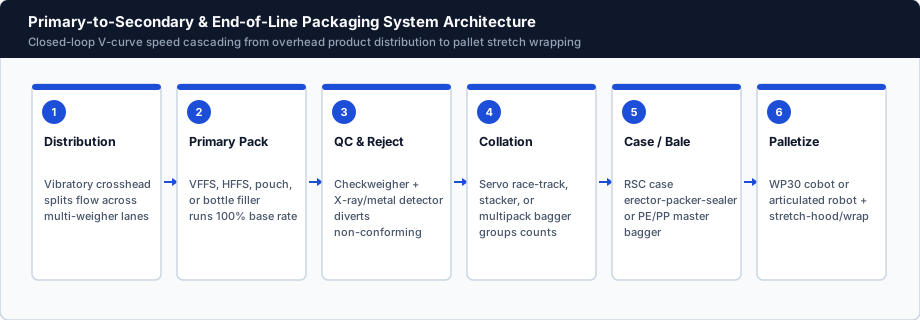
Rigid Bottle Line Station & Buffer Architecture
Station-by-station engineering specs for 250 ml – 5 L rigid container lines:
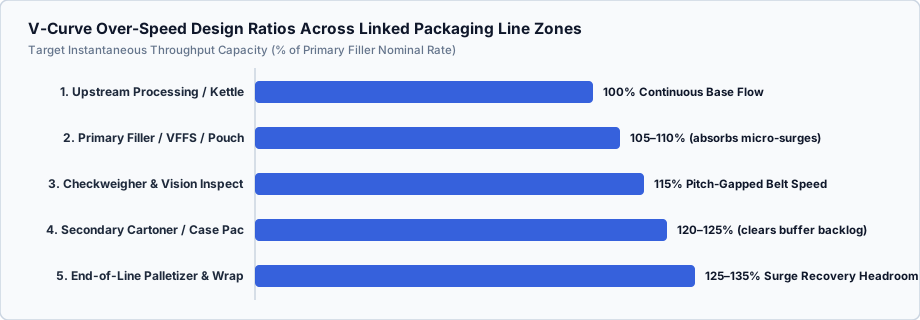
| Station | Core Machine Spec | Line Balance Ratio | Critical Stability / QC Feature |
|---|---|---|---|
| 1. Bottle Unscrambling | CLP-650 rotary pocket unscrambler + air rinser | 110% of filler | Tool-free puck/guide swap for square/oval HDPE |
| 2. Servo Liquid Filling | 6–12 diving nozzles (12.7 / 25.4 mm dia), SUS316L |
100% pacemaker (40–120 BPM) | Drip tray + CIP manifold; ±0.2%–0.5% accuracy |
| 3. Cap + Induction + Label | Vibratory/elevator sorter + servo torque + front/back | 112–118% after 90s buffer | Missing-foil / skewed-cap / OCR vision reject |
| 4. Case Pack & Palletize | Lane divider + 2-axis pick-place RSC packer + robot | 125% surge recovery | Automatic partition inserter for glass jars |
Compare cobot vs articulated palletizers for heavy 15–20 kg liquid cases in robotic and cobot palletizing cells.
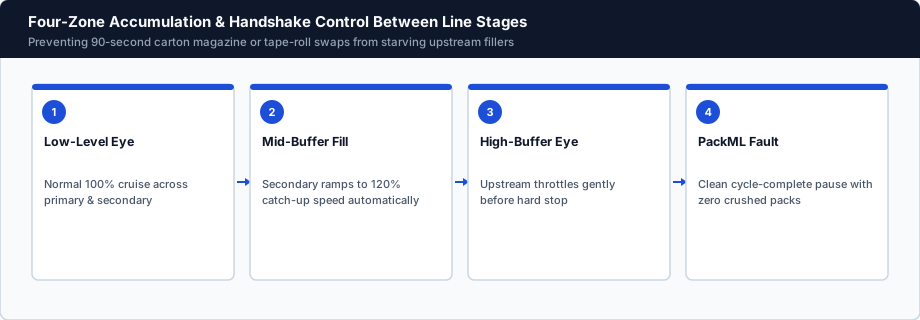
System Integration Engineering Notes
- Mass-Flow Accumulation Around the Labeler: Label roll splices happen every 25–40 minutes—a 90-second bi-directional accumulation table upstream of the labeler keeps the liquid filler running continuously during roll swaps.
- Air Knife Drying Before Self-Adhesive Labeling: External splashes or cold-fill condensation ruin label tack; place twin high-velocity air knives between the rinse/capper and the labeler.
- Corrosive & Solvent Seal Upgrades: Chemical, detergent, and specialty additive lines upgrade wetted seals to PTFE/Kalrez with fume-extraction hoods over filling nozzles.
Design Your Rigid Bottle Packaging Line
Share bottle drawings/volumes (ml to 5 L), liquid viscosity, cap style, and target BPM via Project Brief.
Explore related system modules in Packaging Line Systems, Line Balancing & OEE Specs, or send your floorplan & target BPM via Project Brief.
Related Specifications
Further Reference
Request Project Configuration Review
Share layout constraints, architectural drawings, or throughput targets with Packaging Line Systems Technical Group.
Review My Line Layout