Bridging High-Speed Primary Fillers to Retail Multipack Formats
Club stores, e-commerce fulfillment, and supermarket shelf-ready displays increasingly demand secondary multipacks: 6-to-24 count snack pillow bags inside a printed outer bag, 10-to-30 stick packs neatly stacked inside a tuck/hot-melt carton, or stand-up pouches collated upright in tear-front SRP trays. Within packaging line systems, secondary collation is the mechanical precision bridge between fast single-unit primary machines and outer shipping cases.
Selecting the right collation mechanics—overhead bucket cascade, servo twin-belt race-track, horizontal stacking magazine, or delta vision spider—determines changeover speed and floor length.
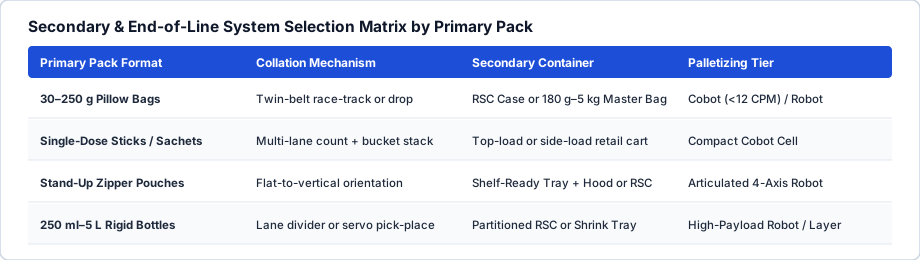
Secondary Collation & Containment Platforms
Match primary pack geometry and count flexibility to secondary machinery:
| Secondary Platform | Primary Infeed Rate | Pack Count Range | Best Retail Format |
|---|---|---|---|
| Primary-into-VFFS Multipack Bagger | Up to 5 × 120 BPM primary | 4–24 pillow packs per outer bag | Savoury snacks, mini-candy, portion packs |
| Stick/Sachet Count-Stack Cartoner | 4–16 lanes (200–800 SPM) | 5–60 sticks/sachets per box | Instant coffee, electrolytes, pharma |
| Horizontal Intermittent/Cont. Cartoner | 40–250 cartons/min | 1–12 flow wraps, blisters, bottles | Bakery bars, tubes, pharma blisters |
| Delta Vision Robotic Tray/Multipack Cell | 80–300+ picks/min | Mixed-flavor variety packs | Assorted pouches, cups, snack bars |
Compare flexible outer baggers in multipack and master baggers and box loaders in cartoning and collation feeders.
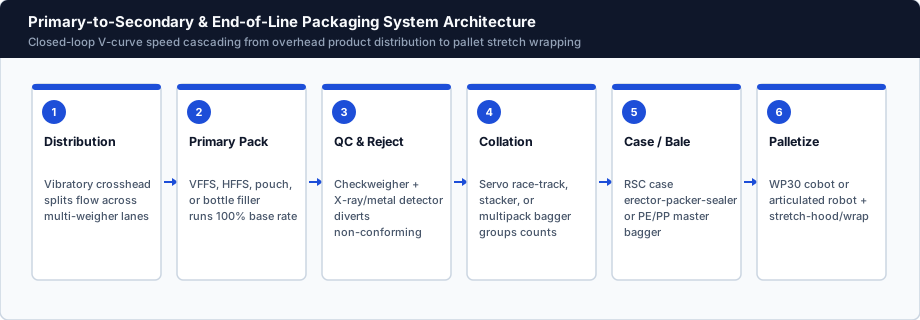
System Integration Engineering Notes
- Bypass Gate for Dual Single/Multipack Lines: Install pneumatic diverter gates above secondary baggers so primary VFFS machines can discharge either straight to RSC cases or into multipack outer baggers.
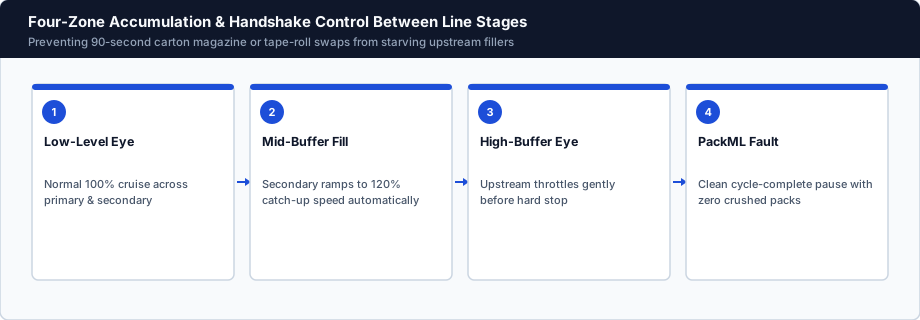
- Count Verification via Dual Checkweighing: A precision secondary checkweigher after multipack bagging or cartoning catches missing 15 g sachets or 30 g snack bags with 100% certainty.
- Quick-Release Change Parts with Scales: Digital handwheel indicators and tool-free carton-lug adjustments keep SKU count swaps under 15–20 minutes.
Design Your Multipack or Cartoning Bridge
Share single-pack dimensions, counts per multipack, and primary BPM via Project Brief.
Explore related system modules in Packaging Line Systems, Line Balancing & OEE Specs, or send your floorplan & target BPM via Project Brief.
In This Section
Related Specifications
Further Reference
Request Project Configuration Review
Share layout constraints, architectural drawings, or throughput targets with Packaging Line Systems Technical Group.
Review My Line Layout