Choosing Between Compact Cobot Cells & High-Speed Articulated Robots
Floor space and cycle rate separate the two dominant palletizing tiers in end-of-line packaging systems. Where a single line outputs 6–12 cartons/min (up to 15–25 kg payload) inside a cramped retrofit bay, a compact WP30-class collaborative/cobot palletizer rolls into the footprint of two manual pallet stations with area laser scanners instead of perimeter cages. Where speeds climb to 15–35+ cartons or heavy master bags/min—or one robot services two or three packaging lines—a caged 4-axis industrial articulated robot with multi-case row tooling dominates.
Both platforms feature drag-and-drop HMI pallet-pattern generators so operators build new Ti × Hi interlocking layers in 3 minutes without writing robot code.
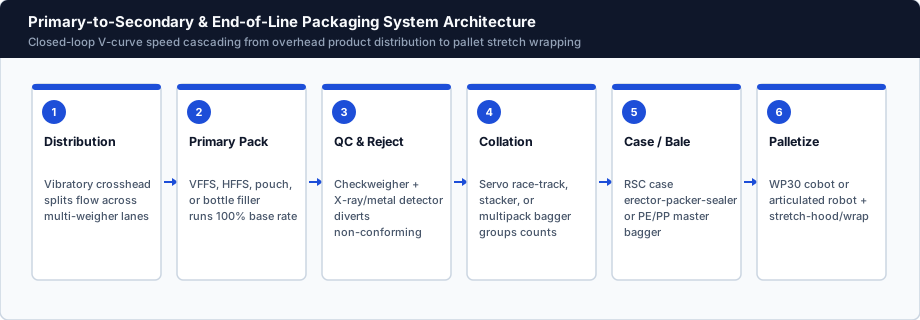
Cobot vs Industrial Robot vs Layer Palletizer Specs
Technical comparison across payload, speed, footprint, and end-of-arm tooling:
| Palletizer Platform | Cycle Speed | Max Payload | Footprint (L × W) | End-of-Arm Tooling (EOAT) |
|---|---|---|---|---|
| WP30 Compact Cobot Cell | 6–12 cartons/min | 20–30 kg | ~2.5 × 3.2 m | Foam vacuum gripper (single/dual pick) |
| Single-Line 4-Axis Robot | 14–26 picks/min | 50–110 kg | ~4.2 × 4.8 m (caged) | Multi-zone vacuum, clamp, or bag finger fork |
| Multi-Line Central Robot | 20–35+ picks/min | 110–180 kg | ~5.8 × 6.5 m | Row-pick servo clamp + slip-sheet suction |
| High-Level Layer Palletizer | 40–80+ cases/min | Full layer | ~7.5 × 4.0 m | Servo row-forming apron + 4-side squaring |
Estimate labor payback in 60 seconds with our end-of-line ROI estimator.
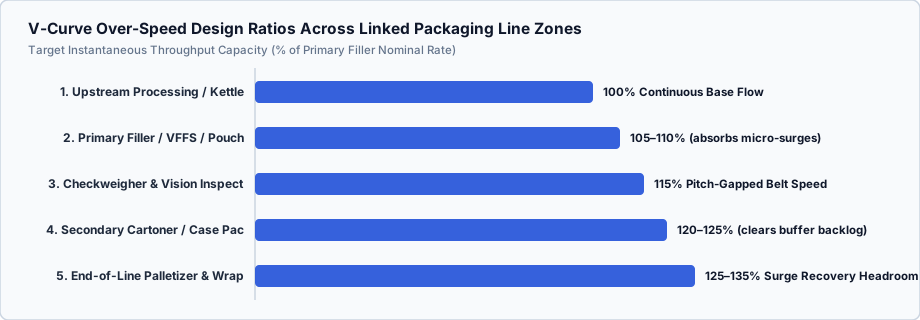
System Integration Engineering Notes
- Finger-Fork Grippers for Flexible Master Bags: Vacuum cups leak on woven-PP sacks or pillowy master bales—specify stainless finger-fork cradle grippers with top stabilizer paddles.
- Telescoping Pillar for Tall Export Pallets: Compact cobot pedestals use an automatic vertical lifting column to stack full
2,100–2,300 mmhigh-cube container pallets. - Integrated Rotary-Arm Stretch Wrapping: Unstable light snack cartons benefit from rotary-arm wrappers where the pallet stays stationary while the film carriage orbits at 15–30 RPM.
Match a Palletizer to Your Case Weight & Aisle Space
Share max carton/bag weight, cases/minute, and max stack height via Project Brief.
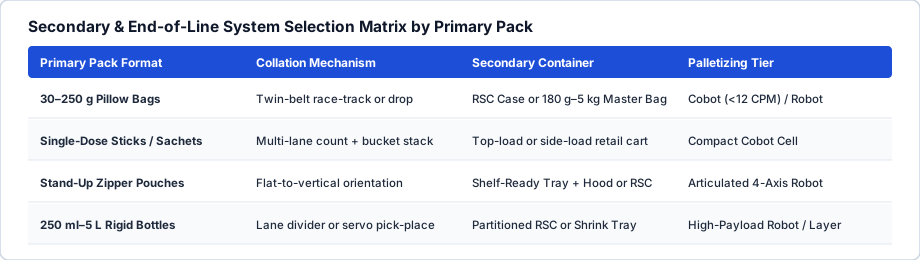
Explore related system modules in Packaging Line Systems, Line Balancing & OEE Specs, or send your floorplan & target BPM via Project Brief.
Related Specifications
Further Reference
Request Project Configuration Review
Share layout constraints, architectural drawings, or throughput targets with Packaging Line Systems Technical Group.
Review My Line Layout