The Compound OEE Trap in Unbuffered Series Lines
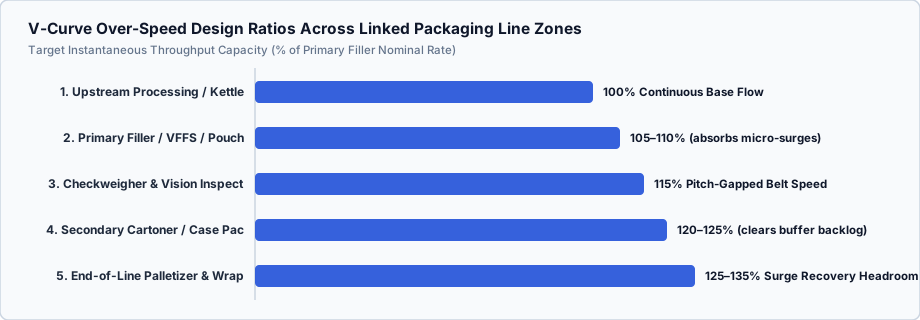
Five machines connected rigidly in series—each running at 92% standalone availability—deliver only 0.92^5 = 65.9% combined line availability! Without decoupled accumulation buffers and progressive downstream over-speeding, every minor label splice, carton blank jam, or pallet exchange halts the entire line. System-level line balancing breaks rigid coupling by placing calculated FIFO or mass-flow buffers around the line’s constraint machine and graduating downstream speeds along a V-curve.
When the primary filler or multihead bagger serves as the line pacemaker (100%), upstream feeding and downstream secondary/end-of-line modules are sized 15–35% faster so temporary queues clear smoothly without operator intervention.
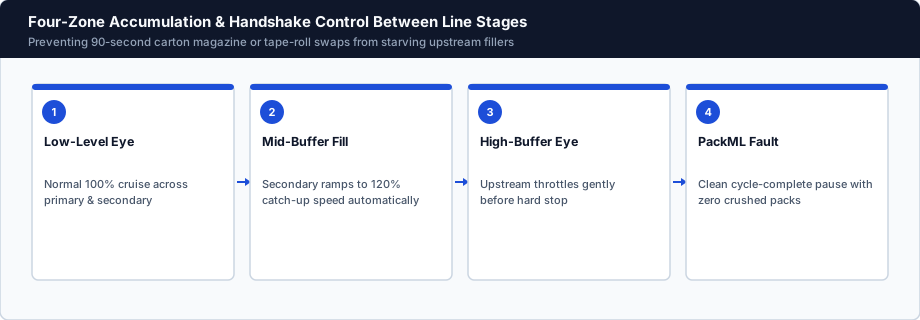
Accumulation & Handshake Engineering Standards
Reference buffer durations, conveyor mechanics, and PLC interface signals:
| Interface Boundary | Target Buffer Window | Buffer Hardware Type | PLC Handshake Standard |
|---|---|---|---|
| Process -> Primary Weigher | 60–180 sec surge | Modulating vibratory crosshead + level probes | Analog 4–20 mA / EtherNet-IP demand |
| Bottle Filler -> Labeler | 90–180 sec mass flow | Bi-directional accumulation table / spiral | 3-level photoeye VFD speed trim |
| Primary Pouch -> Case Packer | 45–90 sec FIFO | Indexing belt cascade / vertical paternoster | PackML Starved / Blocked / Execute bits |
| Case Sealer -> Palletizer | 60–120 sec case queue | Zero-pressure roller accumulation zones | 24V zone release + barcode lane sort |
Run your exact shift availability and buffer recovery numbers in our line balancing and buffer calculator.
System Integration Engineering Notes
- Bag Conditioning & Flattening Before Case Loading: Flexible pillow bags trapped with headspace air bounce off pick-and-place cups—install dual-belt spring-loaded bag flatteners + incline settling conveyors ahead of the case packer.
- Reject-Verify Before Secondary Containment: Always mount checkweighers and metal/X-ray inspection on single primary packs before collation so one off-weight pouch scraps 30 g instead of an entire 24-pack case.
- Zero-Pressure Case Accumulation: Motorized 24V DC MDR roller zones prevent heavy 15 kg liquid cases from crushing rear cartons while waiting for pallet exchange.
Audit Your Current or Planned Packaging Hall
Send your current machine list, cycle speeds, and top three micro-stop causes via Project Brief or review sizing guides in line sizing and turnkey planning.
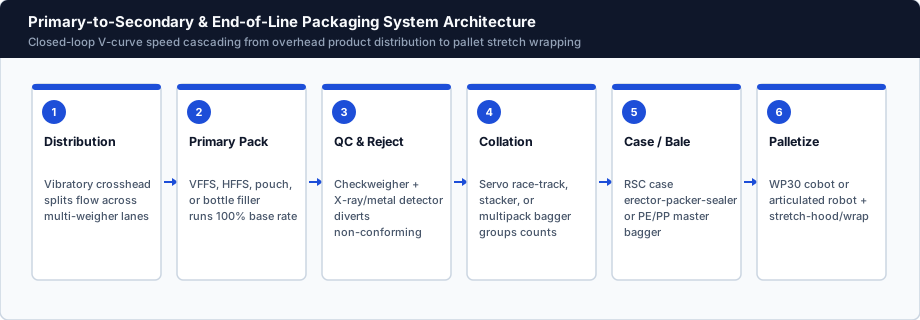
Explore related system modules in Packaging Line Systems, Line Balancing & OEE Specs, or send your floorplan & target BPM via Project Brief.
In This Section
Further Reference
Request Project Configuration Review
Share layout constraints, architectural drawings, or throughput targets with Packaging Line Systems Technical Group.
Review My Line Layout