Bag-in-Bag Economics: Retail Variety Packs & Corrugated Replacement
Secondary flexible bagging solves two distinct commercial missions inside secondary multipack and cartoning: retail multipacks (e.g., 6 × 30 g potato chip pillow packs inside a printed 180 g supermarket outer bag) and industrial master baling (grouping 10–50 primary pouches of rice, sugar, flour, detergent, or pet food inside a tough 140–180 μm M-fold PE or woven-PP outer bale, cutting shipping packaging cost 50–65% vs corrugated boxes).
Reference snack topologies link five 120 BPM primary VFFS machines (RQ550 class) directly into three large-tube secondary baggers (R800 class) via inclined collector conveyors and count-check gates.
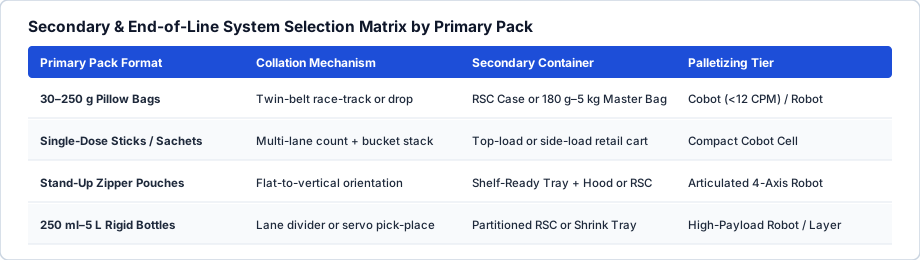
Retail Multipack VFFS vs Industrial Master Bagger Specs
Specification comparison across outer bag dimensions, film gauge, and collation:
| Specification | Retail Multipack VFFS (R800 Class) | Horizontal / Vertical Master Bagger |
|---|---|---|
| Outer Bag Width × Length | 180–400 × 220–550 mm | 350–450 × 650–900 mm (gusseted 80–150 mm) |
| Outer Web / Bag Material | 50–90 μm laminated BOPP/CPP or PE | 140–180 μm M-fold LDPE roll or premade woven PP |
| Count Range & Payload | 4–24 packs (120 g – 1.5 kg) | 10–50 packs (5 – 25 kg shipping bale) |
| Cycle Speed | 25–65 multipacks/min per bagger | 6–18 tightened brick bales/min |
| Drop Cushioning | Angledforming tube + air-expulsion sponges | Horizontal compression plunger -> tight rectangular bale |
See full upstream weigher layouts in snack and granule multi-weigher lines.
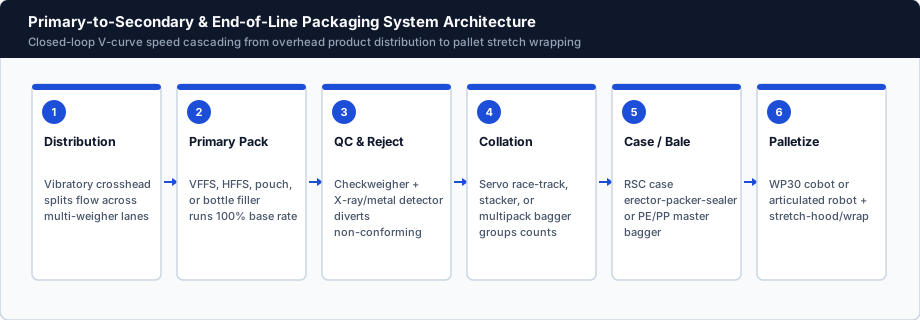
System Integration Engineering Notes
- Controlled Deflation Without Crushing Chips: Secondary snack baggers use timed soft-foam gusset tuckers and micro-perforations so outer multipacks palletize flat without popping inner N2-flushed bags.
- Brick-Shaped Master Bales Stack Like Boxes: Horizontal compression master balers square 1 kg flour/sugar pouches into tight brick bundles that stack 8–10 layers high on export pallets with zero corrugated board.
- Dual-Checkweigher Missing-Pack Divert: Any multipack weighing 1 primary-bag light is blown off onto a rework table so operators slit only the outer film and recover all good inner packs.
Configure Your Bag-in-Bag Multipack or Master Line
Send primary bag L × W × thickness, count per outer bag, and total BPM via Project Brief.
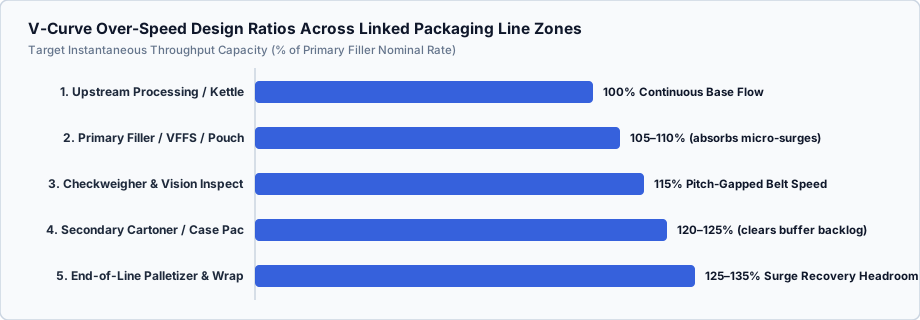
Explore related system modules in Packaging Line Systems, Line Balancing & OEE Specs, or send your floorplan & target BPM via Project Brief.
Related Specifications
Further Reference
Request Project Configuration Review
Share layout constraints, architectural drawings, or throughput targets with Packaging Line Systems Technical Group.
Review My Line Layout